
How to Hire Security Guard Companies in San Francisco
If you manage property in San Francisco and you’ve collected three security bids, you’ve probably noticed something odd: the numbers don’t line up with what you’d expect, and the proposals all say roughly the same things about “trained professionals” and “24/7 coverage.”
Most vendor-selection advice you’ll find online is written for anywhere. It tells you to check licensing, ask for references, and compare pricing. Fine advice. None of it explains why security guard companies in San Francisco’s quotes look different from companies in San Jose’s quotes for what appears to be an identical scope of work, or what a downtown high-rise actually needs that a suburban campus doesn’t.
This guide covers what to verify, what to ask, and what the answers should sound like for security guard companies in San Francisco.
Why a San Francisco quote isn’t comparable to a San Jose quote
This is the single most common source of confusion for property managers who oversee buildings on both sides of the Bay. The same vendor, the same scope, and the San Francisco site comes back meaningfully higher per hour. It usually isn’t a markup on your zip code. It’s the cost of employing someone inside city limits.
Two San Francisco requirements drive it:
The city minimum wage. San Francisco’s minimum wage rose to $19.61 per hour on July 1, 2026. San Jose’s 2026 rate is $18.45. That alone is over a dollar an hour before anything else is factored in.
The Health Care Security Ordinance (HCSO). This is the one almost nobody explains, and it’s the bigger number. San Francisco requires covered employers to spend a minimum amount on healthcare for every hour an employee works inside the city. For 2026, large employers (100 or more employees worldwide) must spend $4.11 per hour payable. Employers with 20 to 99 employees must spend $2.74 per hour. Coverage kicks in for employees who have been on staff more than 90 days and regularly work at least eight hours a week in San Francisco. And it has to be an actual, irrevocable healthcare expenditure. Adding the money to a paycheck doesn’t count.
Put them together, and a San Francisco post carries roughly five dollars an hour in additional mandated cost before payroll taxes, workers’ comp, uniforms, supervision, or any margin. San Francisco also has its own paid sick leave ordinance on top of state requirements.
None of this means your guard earns minimum wage, and it shouldn’t. Professional guards are paid well above the floor. But it does mean two things worth knowing when you’re comparing bids:
- A San Francisco bill rate that matches a suburban one deserves a question. Not an accusation, a question. Ask how the vendor is meeting HCSO for the guards assigned to your building.
- The cheapest San Francisco bid is often the one to look at hardest. When a rate can’t cover the mandated cost of employment plus reasonable supervision, something has to give. Usually it’s guard pay, which leads to turnover, which means a stranger at your desk every eight weeks.
If you want the longer version of how cheap hourly rates create expensive outcomes, we covered that in our piece on what actually drives a security guard budget.
How to verify a security company’s license yourself
Every legitimate security company in California operates under a Private Patrol Operator (PPO) license from the Bureau of Security and Investigative Services. Every individual guard carries a separate registration, commonly called a guard card. Companies say this in proposals constantly. Very few property managers check, and it takes about ninety seconds.
Here’s the process:
- Go to the California Department of Consumer Affairs license search at search.dca.ca.gov. This is where BSIS now directs the public.
- Select Private Patrol Operator as the license type for a company. Select Security Guard to check an individual officer.
- Search by license number instead of business name. Numbers avoid the confusion of similar-sounding company name.
- Confirm four things: the status is current, the legal business name matches the entity on your contract, the address of record is real, and there are no disciplinary actions flagged.
Run the numbers yourself and check the legal entity name against the company you’re actually signing with, since the marketing name and the licensed entity aren’t always the same. If your site requires armed officers, those guards need a separate exposed firearm permit.
Every PPO must also designate a Qualified Manager, a specific licensed individual responsible for day-to-day operations. Asking who that person is and whether they’re based in the Bay Area is a fast way to find out whether you’re hiring a local company or a national brand with a local phone number.
For the record, ours is PPO 121647. Look it up.
What San Francisco buildings actually require
Security scopes written for a suburban office park get copied onto San Francisco buildings, and they don’t fit. The building stock is different, and so is what goes wrong.
Vertical patrol, not perimeter patrol. A Financial District tower doesn’t have a fence line. It has a lobby, elevator banks, stairwells, mechanical floors, a loading dock, and three or four levels of subterranean parking. A patrol route here is a sequence of floors and access points, not a walk around a building. Ask any bidder to describe the route they’d actually run at your property, floor by floor. Vague answers mean they haven’t thought about your building specifically.
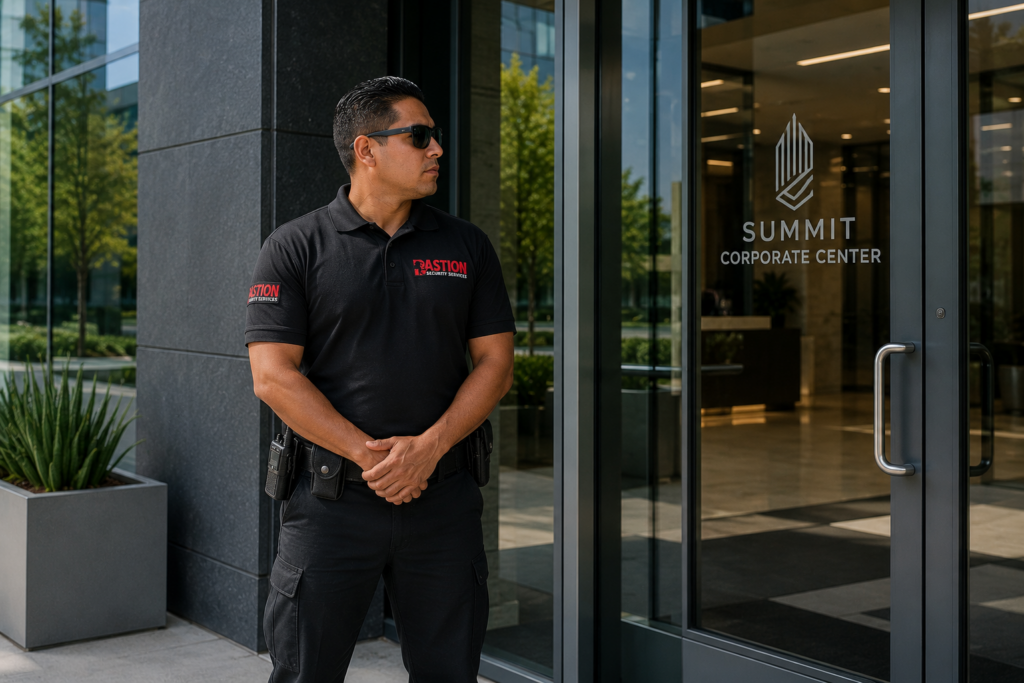
Multi-tenant lobbies as the real control point. In a single-tenant suburban campus, everyone in the lobby belongs there. In a multi-tenant SF high-rise, the lobby is a public-facing space with dozens of employers, constant visitor traffic, courier and food-delivery volume, and tenants with wildly different security postures. The officer at that desk is running visitor management, access control, package handling, and first impressions simultaneously. That’s a concierge security role, and a different hire than a construction site.
Transit adjacency. Buildings near Montgomery, Embarcadero, Powell, and Civic Center stations, and along the Market Street Muni corridor, see foot traffic that suburban properties don’t. That changes lobby staffing hours, garage entrance monitoring, and how you handle the sidewalk-adjacent portions of your property.
Partial-floor occupancy. Downtown occupancy patterns have shifted permanently. Plenty of SF towers now have vacant or lightly occupied floors above active tenants. An empty floor with working elevator access is a security condition, not just a leasing problem, and it should appear in your post orders.
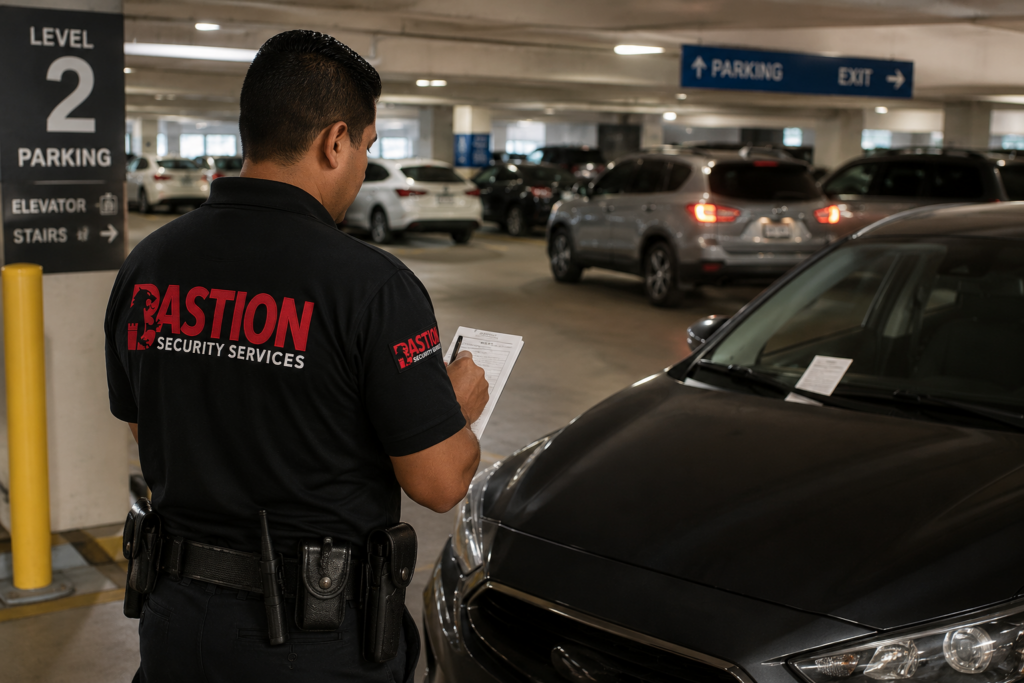
Garages and loading docks. Subterranean parking is where most incidents at SF commercial properties actually originate. If a proposal treats the garage as an afterthought, it was written for a different city.
The questions worth asking every San Francisco bidder
Skip the generic vendor questions for a moment. These are the ones that separate companies that operate in San Francisco from companies that dispatch into it:
Where is your nearest office, and who manages this building? Not the sales rep. The operations person who shows up when something goes wrong. Ask where they physically work.
Who answers the phone at 3 a.m., and where are they sitting? A dispatcher who knows your building’s layout and a dispatcher reading a script in another time zone produce very different outcomes at 3 a.m.
How do you meet HCSO for guards assigned to this property? A straightforward question with a straightforward answer if the company is compliant. Hesitation here tells you something.
Do you employ your officers directly, or subcontract? Subcontracted coverage means the person on your property may not be employed by the company you’re paying, which affects training consistency, accountability, and your liability picture.
What’s your turnover rate at San Francisco sites specifically? Not company-wide, not nationally. In this city, where the cost of employing someone is highest, turnover is where a low bid shows up.
Can you walk my building with me before quoting? A company that bids from a floor plan is guessing. A company that walks your garage, rides your elevators, and checks your loading dock will write post orders that work.
What will your reporting look like, and can I hand it to my insurer? GPS-verified checkpoints, time-stamped daily activity reports, photo documentation. Ask to see a real sample report, not a mockup.
Red flags
- No PPO number offered, or one that doesn’t verify. Non-negotiable.
- A San Francisco rate that matches a suburban rate. The math has to work somewhere.
- No physical Bay Area presence. A mailing address is not an office.
- Subcontracting they didn’t disclose until you asked.
- Post orders that never mention your garage, loading dock, or elevator banks.
- Claims of police authority or special city status.
- A proposal that could have been written for any building in any city. If they didn’t customize the bid, they won’t customize the service.
Getting a second opinion on your San Francisco property
Most property managers don’t need a new security vendor. They need to know whether the one they have is right-sized, compliant, and actually covering the parts of the building where incidents start.
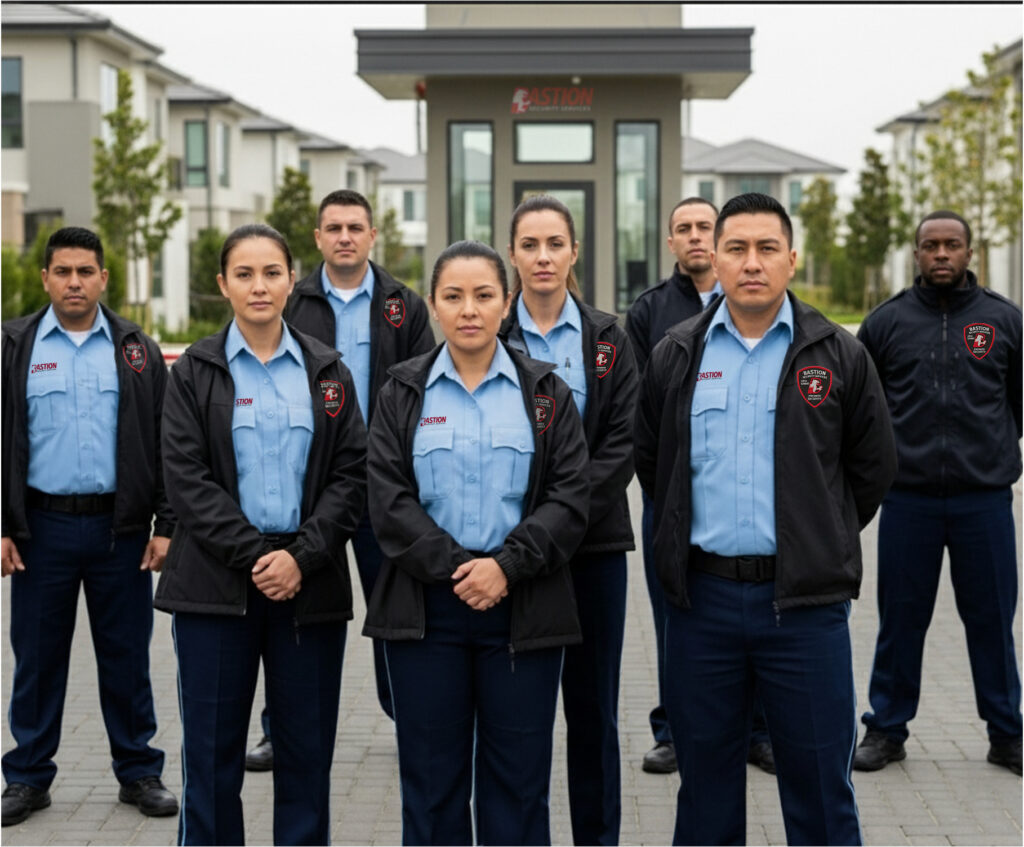
Bastion Security Services operates from offices in San Jose and at 605 Market Street in San Francisco, with local management and 24-hour in-house dispatch. We work with commercial office buildings, HOAs, and residential communities, retail centers, and educational campuses across the city — guards, mobile patrol, concierge coverage, parking enforcement, and camera monitoring.
If you’re comparing proposals, renewing a contract, or just want someone to walk the property and tell you what they see, we’re happy to help.